America’s Gun Obsession
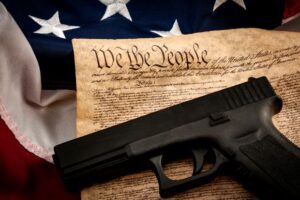
In the United States, one of the clearest dividers between the two main parties in Washington DC is the issue of gun control. Without needing to ask much else, one may easily determine whether an American politician is Republican or Democrat by asking where they stand on the issue, with Republicans heavily favouring relaxed gun laws and fewer restrictions on Americans owning guns, and Democrats favouring tighter restrictions and fewer gun rights, such as open carry. Democrats are also in favour of a federal assault weapon ban, which would outlaw the sale and ownership of weapons such as the popular AR-15; weapons with large magazines designed to kill people. The root of this issue is deeply ingrained into American law, as the Second Amendment has been interpreted by numerous judicial bodies, including, on many occasions, the US Supreme Court, to give the citizenry of the US the right to own guns. The text of the amendment reads as follows; “A well regulated Militia, being necessary to the security of a free State, the right of the people to keep and bear Arms, shall not be infringed.”
What does the Second Amendment mean?
The US Constitution is a very vague document, as evidenced by the positively vast array of laws that have been passed and ratified in the US’s relatively short history as a sovereign nation. If views ranging from the near-socialist policies of someone like Congresswoman Alexandria Ocasio-Cortez, to the far-right wing of Vice President Mike Pence’s borderline Christian fundamentalism, may be deemed legal under one document, it may be assumed that that document is not especially precise in its description of American law. The basics of a free and fair democracy are set out in the Constitution, and freedoms for average citizens are also described, but were later expanded upon when the ambiguity of the constitution led to injustices such as only land-owning white men being able to vote, in the first iterance of voting rights. The expansions first included working-class white men, then white women, and finally people of colour being given the right to vote over the years.
The Bill of Rights
The nebulous nature of the Constitution’s first iterance, the Bill of Rights (or the first ten amendments) led to many more amendments being added over the years, to a total of twenty-seven at present. Not only may amendments be added to the constitution, but they may also be removed, as evidenced by the eighteenth, which made the manufacture and sale of alcohol illegal in the US. This amendment was repealed and replaced by the twenty-first. This shows that while the Constitution is undoubtedly the most important document in the United States, and should be treated with the reverence and respect it deserves, it is also not meant to just be abided and blindly followed. The Founding Fathers of the US made it possible that, if an amendment is revealed to be not in the best interest of the life, liberty and happiness of US citizens, it can be struck from the document.
The Second Amendment in History
The second amendment was very useful and relevant, when the country was nothing more than a newly-liberated colony, forging civilisation in an untamed and lawless wilderness, with hostile foreign powers constantly seeking to conquer or re-conquer the untapped, resource-rich natural environment. There was no standing military, and if states sought to protect themselves from these aggressors, they needed to do it themselves, without support from the fledgling federal government. The “well-regulated militia” bit of the amendment sets this out plainly. When the US had established itself as a free and independent nation, capable of defending its borders and with some considerable diplomatic clout as well, it looked to the expansion of its borders westwards. The arming of enterprising and adventurous citizens as they carved their way towards the Pacific was instrumental in the “Manifest Destiny” mantra that led to the states reaching their final count of fifty. The unregulated and lawless frontier that came about because of this made a gun an essential tool to protect oneself against those who would seek to take everything that one had gained. But, once the invaders had been repelled, once the Pacific had been reached, and once the West had been tamed, what use did a firearm designed to kill human beings have to an ordinary, law-abiding citizen?
The Second Amendment Now
This brings us to today, where the ownership and sale of guns is perhaps one of the most contentious issues in Washington. The modern United States experiences gun violence almost perpetually, with eighty-seven mass shootings taking place in just the last five years. The CDC reported that in 2018, there were thirty-eight thousand deaths by firearm in the US, the majority, twenty-four thousand, being suicides. While the suicide figure shows that an altogether different problem, mental health, is seriously endemic in the US, and banning guns would to little to solve that particular problem, the other eighteen thousand homicides involving a firearm have to potential to be at the very least lessened by tighter firearms restrictions. However gun ownership and use in the US is portrayed by statistics, there will always be individuals who will argue fervently against restrictions to gun ownership.
Self Defence as an Argument
The reason that many Americans own a gun is for self-defence, and it has been shown that in states that allow concealed carry, it can be an effective deterrent for violent crime, although the extent of this effectiveness is debated. There is a very strong case that the dangers and drawbacks of universal access to guns far outweigh the benefits. While it is true that the American people have been free to buy and use guns for as long as the USA has been a nation, for the vast majority of that time the ownership of guns was necessitated by a hostile and lawless environment in which enemies had to be fought, food had to hunted, and criminals had to be deterred in order for the average American to survive.
What if the Constitution were written Today?
Now that the USA has not only a federally funded and regulated National Guard some four hundred and fifty-thousand strong, but police in every county and city who’s job it is to protect Americans from criminals, where does the argument for gun ownership fit in? Hypothetically, if the USA was being formed today, in the twenty-first century, and it was announced that the second law written in that nation’s central legal document gave all citizens the right to own not only firearms specifically for hunting, but military-style assault rifles, handguns and shotguns, there would be international outcry. In 1791, when muskets and flintlock pistols took more than a minute to fire and load one highly inaccurate shot, universal access to these firearms would seem sensible. But now that there are assault rifles that can fire up to and over thirty highly accurate rounds, each with a vastly higher propensity to inflict fatal harm than those around in 1791, in one magazine that can be reloaded in seconds, the sensibility of the second amendment seems almost non-existent.
The population having access to these weapons, purportedly only for self defence, implies at the very least, an endemic deep distrust of law enforcement and the government’s ability to protect its citizens. One of the biggest arguments against the outlawing of firearms is, “You can’t, its in the constitution.” By that logic, the USA would still be sober under the eighteenth amendment. You can abolish amendments to the constitution, it has been done before.
The second amendment is an outdated and dangerous law that has no place in a modern constitution, and should be abolished.
stay safe out there
/e