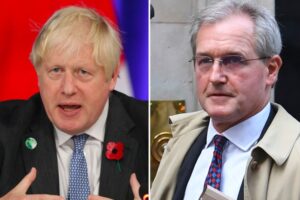
Owen Paterson’s Situation
Owen Paterson, the Conservative MP for North Shropshire, resigned today.
This move follows a lengthy and damning investigation into his conduct by the Parliamentary Standards Authority, which recommended that he be suspended from Parliament for thirty days, the longest suspension recommendation since 1947.
Paterson was found guilty of using his position to approach the Food Standard Agency on ten separate occasions on behalf of two different companies, of using his Parliamentary office to conduct meetings with these companies sixteen times, and of not disclosing any of this information when given opportunities to do so.
Paterson protests his innocence despite these findings, and says that these actions were all attempts to “avert a serious wrong”, the wrong as yet being unspecified.
Conservative Complications
The motion to suspend Paterson from the House was given two amendments; the first by Dr Julian Lewis MP, calling to prevent Paterson’s suspension on compassionate grounds (Paterson very recently lost his wife to suicide, claiming also that the investigation into his conduct exacerbated her condition); the second by Andrea Leadsom MP, calling for the Parliamentary Standards Authority to be essentially replaced by a new select committee, citing “potential defects in the standards system”. Leadsom, as well as Prime Minister Boris Johnson, wanted Paterson’s suspension ignored until the standards were changed.
The committee suggested by Leadsom would have, predictably, had a Conservative majority, and in all probability would have led to Paterson’s exoneration, and Parliamentary standards surrounding paid advocacy becoming significantly more liberal.
If he had been suspended in the manner the PSA concluded, Paterson would have then been subject to a recall petition in his constituency. If ten percent of the responses to this petition had been in favour of replacing him, Paterson would have lost his seat, and would then have to run in a by-election to keep it. His constituency, North Shropshire, is a safe Tory seat, Paterson having enjoyed a twenty-nine thousand vote majority in the most recent general election.
However, the scandal associated with this issue would have increased the risk of the Conservatives losing a safe seat, or at least of decreasing their majority in the constituency, a risk that Boris Johnson would have been loath to undertake.
Whether or not Paterson was pressured to resign by Johnson, or did so of his own volition, is as yet unclear.
Johnson’s Transparent Motives
This issue has drawn a great deal of criticism towards Boris Johnson and his Conservative Government. The Commons has never reduced a suspension term as recommended by the PSA before, let alone changed the entire review system for the sake of one clearly guilty MP.
In the words of Deputy Labour Leader Angela Rayner MP during yesterday’s Prime Minister’s Questions, “In no other profession in our country could someone be found guilty by an independent process, and just have their mates vote them back into the job.” Despite the PM’s objections to the statement, the motives he and his Conservative colleagues had in this matter were almost painfully obvious.
Rayner went on to point out that when a Conservative MP (Rob Roberts) was found guilty of sexual harassment, but avoided punishment by exploiting a loophole, the Conservative government did not change the rules in that instance. On the contrary, the Prime Minister said that the rules could not be changed after the verdict had already been made.
Now that the same process has unanimously found an MP guilty, Johnson and his allies sought to change the rules to save their colleague. Additionally, if Johnson, or any MP in the House thought that the standards around this issue needed to be changed, they could have done so at any point prior to Paterson’s case.
The changes to the PSA are not their own motion, but an amendment to a motion of suspension attached to a live case. If the Conservatives genuinely had concerns about the appeals process of Parliamentary standards, and wished to avoid these accusations, they could have raised the issue at literally any point leading up to this moment. The fact that they wish to change Parliamentary standards at the exact moment when one of their own has been found guilty of breaching them seems incredibly hypocritical.
The Government apparently realised this fact a little later than the rest of us, when Leader of the House of Commons Jacob Rees-Mogg MP was sent to address the House, after the decision not only to ignore Paterson’s suspension, but to also abolish the PSA had already been voted on. Rees-Mogg informed the House that the Government would not proceed with the decision unless there was cross-party support for the action (which, resoundingly, there was not), in what can only be described as a screaming U-turn.
A Dangerous Precedent
This sort of flagrant rule-bending is not uncharacteristic of this Conservative Government. Johnson is a very unorthodox Prime Minister in this regard.
He has similarly disregarded Parliamentary procedure in this way before, when his Home Secretary Priti Patel MP was found to be in breach of ministerial code by a Cabinet Office inquiry; Patel had bullied a senior civil servant in the Home Office into resignation, and had displayed similar behaviours in three other Government departments she had served in.
Usually, a finding of this nature would necessitate the Minister to resign, but Johnson backed Patel, did not call for her to step down, and openly supported her. This prompted one of the Prime Minister’s senior advisors to resign in protest.
The most prominent example of Johnson breaking the rules to further his own goals is his illegal prorogation of Parliament in 2019. He was found to have misled the Queen in order for her to call for the House’s suspension, so he could avoid Parliamentary scrutiny of his Government’s Brexit plans. Johnson and his Government seem to be more willing than any, or all of their predecessors to alter, avoid, or rewrite rules and standing precedents in order to further their policy ambitions and aid party colleagues.
The system of Government in the UK works as well as it does, despite its many imperfections, because of these rules and precedents. Dodging and changing them to suit the whims of Conservative policy may seem like an efficient way of achieving their short-term goals, and so far it seems to be working for them, but what precedent does this behaviour set for successive Governments? What use are independent bodies like the Parliamentary Standards Authority if the sitting Government may alter the way it conducts itself permanently for the sake of one disgraced MP?
The plot only thickens, as the Parliamentary Commissioner for Standards Kathryn Stone, the woman responsible for delivering decisions on MPs conduct to the PSA (the woman who recommended Paterson’s thirty-day suspension), also oversaw investigations into Boris Johnson’s finances earlier in the year. While Johnson was found to have declared his finances correctly, albeit absurdly improperly, he is said to have been annoyed by the investigations.
It is clear that the Prime Minister used the opportunity of Paterson’s suspension to attempt to remove a potential threat to his leadership. The corruption of this Conservative Government is becoming more and more obvious with each scandal, which are becoming so regular they can almost be predicted.
If they continue to alter and ignore the rules and precedents that guide the processes of Government, they will do irreparable damage to our system before the populace wise up to what they’ve done, and vote them out.
stay safe
/e