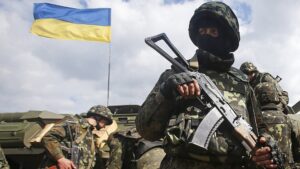
The Situation in Ukraine
The Russo-Ukrainian War might not be at the forefront of international attention as Covid-19 continues to dominate headlines, but the conflict is still very much ongoing. Although no significant amount of territory was exchanged, the Ukrainian Government reported that fifty of its soldiers had died fighting Russian-backed militia in the country’s eastern region of Donbas in 2020. In March, Russia mobilised some eighty-five-thousand troops near its border with Ukraine and in occupied Crimea, bringing shipments of weapons and military equipment from as far east as Siberia. This move was a clear and direct response to NATO troop movements in the region; a sizeable military training exercise codenamed ‘Defender-Europe 21’, conducted jointly between US and NATO, one of the largest in decades, across training areas throughout eastern Europe. The commanding officer of US forces in Europe, Gen. Christopher Cavoli, said the operation was to prove that training could be conducted safely despite the Covid-19 pandemic. Russia’s response to NATO’s posturing has prompted renewed calls from Ukrainian President Volodymyr Zelensky for Ukraine’s requested NATO membership to be expediated.
Ukraine’s NATO Ambitions
Ukraine has had designs to join NATO for decades. The nation formally applied for membership in 2008, but the election of then-President Viktor Yanukovych in 2010 slowed the process down, with Yanukovych preferring to keep ties with Russia and its President Vladimir Putin stronger than ties to the West. This led to his downfall, when he rejected an EU association agreement in 2014, leading to a violent revolution against his goverment, and his eventual ousting and exile. When Russia annexed Crimea in the same year, public support for Ukrainian NATO membership soared, and the new government made NATO membership a priority. Russia, predictably, is staunchly opposed to Ukraine joining NATO, with Russian politician Dmitry Kozak warning that it would mark “the beginning of the end for Ukraine.”
Russia’s Choice
With the rhetoric coming from Russia becoming ever more threatening, and with aggressive policy decisions, such as issuing citizens of Russian-backed separatist oblasts in Ukraine with Russian passports, the conflict is still far from over. Ukrainian membership of NATO would surely prompt further aggression from Russia, but whether Putin would be willing to escalate the conflict if Ukraine had assurances of mutual defence from NATO remains to be seen. Russia is known to take a hard line on the sovereingty of its occupied territory in Ukraine, insisting that it is Russian territory, despite majority opinion in the international community. Ukraine is determined that Russia will have nothing to do with its decision to join or not to join NATO, as is NATO itself, with the organisation’s Secretary General Jens Stoltenberg saying that Russia will not be able to veto Ukraine’s decision, “as we will not return to the era of spheres of interest, when large countries decide what smaller ones should do.” Hopefully, if Ukraine’s membership to NATO is finalised, Russia will stop acting as if Ukraine is still its satellite state, and allow the independant nation to distance itself from, or move itself closer to Russia, or the West, as it’s democratically elected government sees fit.
stay safe
/e